
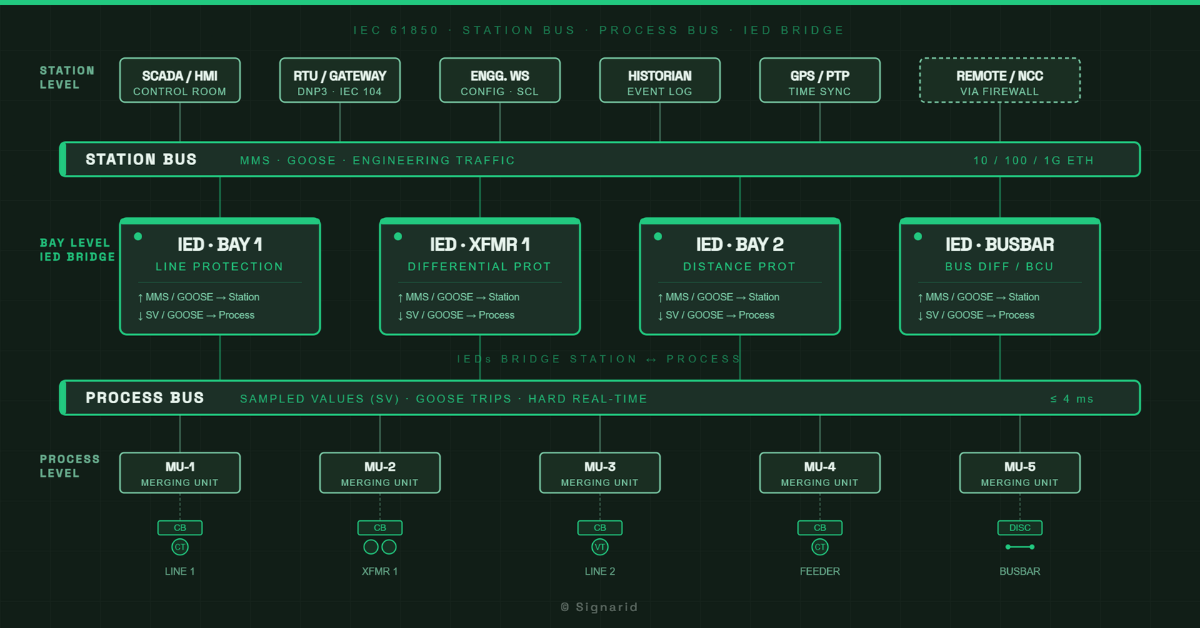
The station bus vs. process bus decision comes up on every IEC 61850 project — and it is one of the decisions where a wrong call on paper becomes an expensive problem in the panel room. Understanding what each bus does, where it lives in the substation, and what trade-offs come with each option is fundamental to designing a system that actually works at commissioning.
What Station Bus and Process Bus Actually Do
In an IEC 61850 substation, the station bus connects IEDs (Intelligent Electronic Devices), the HMI, the gateway, and the engineering workstation. It carries MMS (Manufacturing Message Specification) for supervisory communication and GOOSE messages for fast peer-to-peer signalling between protection and control IEDs. The station bus is the older, more established topology — most digital substations built in the last decade use it.
The process bus goes a step further. It moves the analogue-to-digital conversion out of the IED and into a merging unit mounted directly on the primary equipment — the CT and VT marshalling box, or on the switchgear itself. Sampled Values (SV — IEC 61850-9-2) carry instantaneous current and voltage measurements over Ethernet from the merging unit to the IED. The copper pilot cables connecting marshalling boxes to relay panels are replaced with fibre.
These are not competing options for the same problem. They solve different parts of the substation architecture.
When Station Bus Is the Right Call
Station bus is the default for most projects today, and for good reason. The technology is mature, IED interoperability is well-tested across multiple OEMs, and the engineering tools are established. If your project involves:
- Retrofit or extension of an existing substation where primary equipment stays in place
- A mixed-vendor protection scheme where GOOSE trip and blocking signals need to cross between IEDs
- A budget or timeline that does not support a full process bus pilot
…then station bus is the right starting point. The GOOSE performance on a well-designed station bus (sub-4ms end-to-end) is more than adequate for most protection applications.
When Process Bus Makes Sense
Process bus starts to make sense when the project is a greenfield installation, when the primary equipment is being replaced anyway, and when the client has a specific driver — reducing copper wiring cost at scale, standardising measurement infrastructure, or future-proofing the yard for an architecture where IEDs are consolidated or virtualised.
The honest trade-off: process bus requires more upfront engineering rigour. Merging unit configuration, Sampled Values subscription mapping in the IED, and time synchronisation accuracy (you need ±1 µs or better for SV — not the ±1 ms that station bus GOOSE can tolerate) all add commissioning complexity. If the project team has not done a process bus commissioning before, that complexity shows up at FAT.
The Architecture Decision in Practice
The question is not “which bus is better.” The question is: what does this specific project need, and what will the project team be able to commission and maintain?
A common mistake is specifying process bus on a project because it looks modern in the architecture drawing, without accounting for the merging unit CT/VT accuracy classes, the PTP grandmaster infrastructure, or the IED vendor’s SV stack maturity. The station bus equivalent of that same bay — GOOSE trip + MMS supervisory — would commission in a fraction of the time.
Station bus with well-engineered GOOSE schemes remains the right answer for the majority of projects in GCC and India today. Process bus has its place — but that place is earned by the project scope, not assumed because the standard supports it.
SCL Configuration Implications
The choice between station bus and process bus also shapes your SCL file structure. On a process bus scheme, the SampledValueControl blocks and the ExtRef bindings in the IED’s IED section look very different from a station bus GOOSE scheme. If you are inheriting a project’s SCL and need to quickly understand which topology was used, check whether the IED sections reference SMV datasets — that tells you immediately.
Internal links: For an explanation of substation network design principles that apply to both topologies, see [Designing Substation Networks for Sub-4ms Protection]. For a breakdown of how GOOSE sits in the protocol stack, see [GOOSE vs. DNP3 vs. Modbus: Choosing the Right Protocol].
If your team is working through IEC 61850 architecture decisions on a live project, Signarid’s corporate training programmes are built around exactly these trade-offs — vendor-neutral, sequenced around how real projects run.