
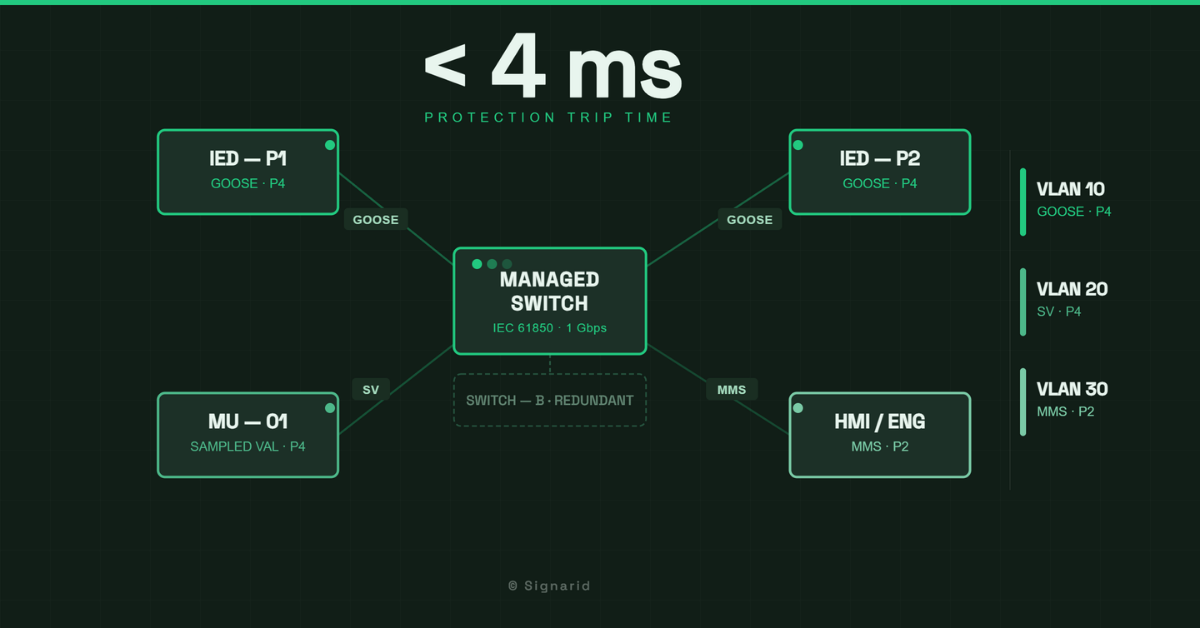
Substation network design for IEC 61850 is not an IT networking problem with a substation label on it. The network is the protection system. GOOSE messages carrying trip signals, inter-trip commands, and blocking logic have a worst-case end-to-end transmission time requirement that most enterprise network designs would consider aggressive. Getting the LAN design right — topology, VLAN structure, QoS, and switch selection — is what makes IEC 61850 protection actually perform.
Why Substation Network Design Is a Protection Engineering Problem
IEC 61850-5 defines a transfer time class for GOOSE messages used in protection applications: Type 1A, ≤3ms for the fastest class (such as direct trip or differential protection interlock). The entire network path — publisher IED to managed switch to subscriber IED — must complete within that budget, including any switch queuing delay.
A standard enterprise managed switch with default QoS settings will not reliably deliver sub-4ms GOOSE performance under load. The problem is queuing: if a burst of MMS traffic or SCADA polling occupies the output queue ahead of a GOOSE frame, the GOOSE message waits. In a protection context, that wait is not acceptable.
This is why substation network design requires explicit QoS configuration, not just capable hardware.
VLAN Segmentation in the Station LAN
A well-designed station LAN separates traffic types into distinct VLANs. A typical segmentation for an IEC 61850 station bus:
- VLAN 10 — GOOSE: All GOOSE publisher and subscriber IEDs. Highest QoS priority. No routed traffic.
- VLAN 20 — MMS: Supervisory traffic between IEDs, HMI, historian, gateway.
- VLAN 30 — Sampled Values (if process bus): Merging unit SV streams to subscribing IEDs. Separate VLAN to contain multicast SV bandwidth.
- VLAN 40 — Management: Engineering workstation access to IED web interfaces and configuration ports. Lowest priority, access-controlled.
- VLAN 50 — Time sync: PTP traffic on a dedicated VLAN if using boundary clock switches; or separated physically where grandmaster redundancy requires it.
VLAN segmentation does two things: it contains the multicast domains so GOOSE and SV floods do not consume bandwidth on ports that do not need them, and it provides the traffic boundaries that support the security architecture.
QoS: Where Most Designs Fall Short
IEC 61850 QoS is based on IEEE 802.1Q VLAN tagging and IEEE 802.1p priority bits (PCP — Priority Code Point). GOOSE frames carry PCP=4 by default (some implementations use PCP=6). The switch must honour these priority bits in its egress queues.
The common failure: switches are specified and procured with the right hardware capabilities, but the QoS configuration in the switch firmware is left at factory default — which typically maps all traffic to the same queue. The protection engineer assumes QoS is active because the hardware supports it. It is not.
During commissioning, a GOOSE timing test under network load is the only way to verify actual performance. Injecting background MMS traffic and measuring GOOSE end-to-end latency with a network analyser gives you the real number.
Switch Selection and SFP Considerations
For substation-grade managed switches, the key requirements beyond QoS:
- Extended temperature range: -40°C to +85°C for switchgear-mounted applications
- IEC 61850-3 compliance: EMC and environmental qualification for substation environment
- IEEE 1588 Boundary Clock support: If PTP time sync runs over the same network
- SFP selection: Single-mode fibre for inter-panel runs over 100m; multi-mode for intra-panel. Always verify wavelength and connector type against the IED’s SFP cage specification — SFP incompatibility is a surprisingly common commissioning delay.
PRP and HSR (Parallel Redundancy Protocol and High-availability Seamless Redundancy — IEC 62439-3) provide zero-switchover-time redundancy for the station LAN. PRP uses two independent networks in parallel; HSR uses a ring topology. Both eliminate the recovery time of RSTP (Rapid Spanning Tree) which, even at its fastest, is not suitable for protection-grade GOOSE availability.
Internal links: For the time synchronisation infrastructure that runs on this network, see [PTP IEEE 1588 vs. IRIG-B]. For the security zoning that maps onto this VLAN structure, see [Substation OT Cybersecurity].
Corporate training on IEC 61850 network design — including switch configuration, QoS validation, and PRP/HSR commissioning — is available through Signarid’s training programmes.